Contemporary Dance Classes in Exeter
Contemporary Exeter
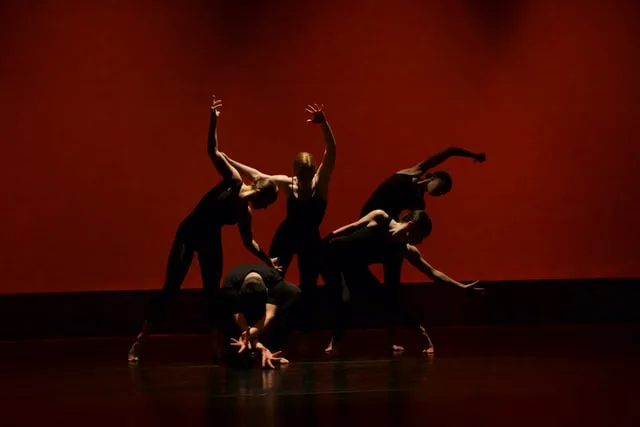 Contemporary — Exeter
Class is coming soon
Fill out the form for more info
Class Details
Location: TBC
Day: TBC
Time: TBC
Age Group: 17 – 75
Teacher: —
Class Structure
Beginners Class — 60 Minutes
Down before up
We start low — spine rolls, shoulder release, breath finding its way into the movement — so the body arrives before the choreography does.
Weight, given and caught
The style's signature give-and-take: dropping weight into the floor, catching the rebound, learning that falling is a technique.
Travelling phrases
Movement crosses the room — slides, spirals and level changes that carry your weight from point to point without a fight.
A phrase or a prompt
Short set choreography or a structured improvisation task, depending on the week — both teach the same thing: intention over imitation.
Settling
Long stretches and a genuinely quiet minute. Contemporary works the body hard and the head gently, and this is where both land.
About Contemporary Classes in Exeter
Exeter is a better contemporary city than most its size. Touring work comes through the Northcott and Exeter Phoenix regularly, the university keeps a stream of movement-curious people flowing through town, and the style's whole premise — movement built from weight, breath and honest physics rather than a fixed silhouette — suits a city this unhurried. What has been missing is a true beginners' room. This is it.
Our sessions work from release technique: softening one part of the body so another can travel, letting breath start the movement, treating the floor as a partner instead of a hazard. Nothing is judged against an ideal shape. If you have done ballet or jazz, this adds the grounded end of the spectrum; if you have done nothing at all, contemporary is the style most forgiving of that.
The class runs centrally, around Queen Street and Gandy Street near Exeter Central, with river-flat walking from the High Street. Private sessions travel across Devon — and yes, the studio has a proper sprung floor, because an hour this floor-based deserves one.
Browse all 20 of our dance classes in Exeter, or see contemporary classes in our other 66 cities.
Fill Out the Form for More Info
Fill in your details for up-to-date class info.
Why Choose Contemporary in Exeter?
Movement on your terms
The technique serves expression, not the other way round — there is no fixed shape you are failing to be.
Strength that protects
Controlled falls, floor work and suspensions build functional strength through the spine, core and joints.
A quieter head
Breath-led movement and improvisation give the mind one job. Plenty of regulars treat the hour as their weekly reset.
£8, no term to join
Flat drop-in price on the night — no enrolment, no block, no obligation past the hour itself.
Your Contemporary Journey
From first class to confident dancer — here is how it usually goes.
Meeting the floor
Rolling and spiralling
The floor stops being where you end up and becomes somewhere you choose to go — the first real threshold.
Breath leads
Movement begins on an exhale rather than an effort, which changes how everything else feels.
The technique proper
Fall and recovery
Contractions, suspensions and the controlled fall — the grammar contemporary borrowed from gravity itself.
Level changes
Standing, kneeling and floor work stitch together until height becomes just another direction.
Finding your material
Improvisation, structured
Guided tasks — an image, a texture, another mover — build the confidence to generate movement rather than only copy it.
Dynamics
Heavy, light, sudden, sustained: you learn to choose a quality, not just a step.
Longer, deeper, yours
Extended sequences
Floor, standing and travelling work join into pieces that stretch stamina and memory together.
Watching differently
Touring contemporary at the Northcott or the Phoenix stops looking abstract and starts looking like decisions you now recognise.
Contemporary in Exeter FAQ
Everything you need to know before your first class.
I do not really understand contemporary dance — can I still start? +
That is the normal starting point. The class teaches from physical basics — weight, breath, the floor — not from theory. Understanding arrives through the body, usually by week three.
What happens in a typical Exeter session? +
A floor-based warm-up, weight and release technique, travelling phrases, then either short choreography or structured improvisation, closing with long stretches. Hard work, gently paced.
What should I wear? +
Fitted leggings and a close top, hair tied back, bare feet or grip socks. Avoid anything baggy — you and the teacher both need to see how your spine is moving.
How much does it cost? +
£8 per class, flat, paid on the night. There is no term enrolment and no minimum attendance.
Where do you teach contemporary in Exeter? +
Centrally, in the Queen Street and Gandy Street quarter near Exeter Central, on a sprung floor — the exact studio is confirmed when you book.
Is improvisation compulsory? It sounds terrifying. +
It is structured, optional in scale and never performed solo in front of the room. Most people fear it for two weeks and then name it as their favourite part.
Will floor work hurt my knees? +
It is taught to avoid exactly that — weight paths go through padded lines of the body, not bone. Knee sleeves are welcome while you learn, and the sprung floor does its share.
Is there contemporary dance to watch in Exeter? +
Yes — touring companies come through the Northcott and Exeter Phoenix across the year, and watching with a term of classes behind you is a genuinely different experience.
How do I join a class? +
Send your details through the form on this page and we will reply within a working day with the next beginner session, the address and what to wear.