Jazz Dance Classes in Bath
Jazz Bath
 Jazz — Bath
Class is coming soon
Fill out the form for more info
Class Details
Location: TBC
Day: TBC
Time: TBC
Age Group: 17 – 75
Teacher: —
Class Structure
Beginners Class — 60 Minutes
Warm And Loosen
A gentle warm-up first, then we isolate — moving the ribs, the hips and the shoulders on their own, each in turn. It feels mechanical at first and is meant to; separating the parts is what gives jazz its later clarity.
The Diagonal
Most jazz numbers eat up space, so we work the travelling vocabulary corner to corner — walks, chassés, a pas de bourrée — building the reach and the straight lines that let the style read from the back of a hall.
Spinning Without The Dizziness
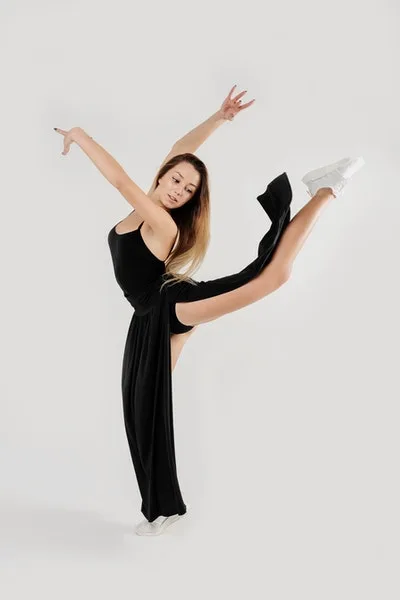
We introduce the turn and the kick slowly. First comes spotting — fixing your eyes to kill the spin — then raising a leg with control rather than launching it skyward and hoping for the best.
A Short Number
Every session lands a bite-size routine choreographed to a track from a musical or the current charts. It arrives in small eight-count chunks, layered up slowly, so a whole piece assembles without ever feeling like a scramble.
Perform, Then Cool Down
The combination gets danced right through together, performed rather than marked, and then we spend real time stretching — jazz asks a lot of the hips and hamstrings, so the wind-down genuinely matters.
About Jazz Classes in Bath
Long before anyone here taught jazz, Bath was a dancing city. The Assembly Rooms opened in 1771 as the grand space where Georgian society came to move through an evening's set dances. We teach none of that and hold no tie to the Rooms whatsoever, but it is a fair reminder that performing in front of others runs deep in this town — and modern jazz shares exactly that appetite for being watched, dressed up in snap and swing.
So what is it, really? Jazz is theatrical dance built on isolations, turns, kicks and a strong sense of attack — the vocabulary that quietly underpins musical theatre and most commercial choreography. Pick it up and you tend to absorb other styles faster, since so many of them borrow its shapes. In the room that means we drill control before flash: how to stand, how to move one part while the rest holds still, how to finish a shape without letting it trail off.
Our studios sit in the middle of Bath — around SouthGate and Stall Street, and up in independent, arty Walcot — so you are never far from Bath Spa station or a bus in. Nobody is asked to drop into a full split on night one; those opening weeks go to building carriage and posture, and the showy turns and kicks only arrive once that base is solid. Every class is a flat £8 on the door with no term to commit to, which makes a weekly hour a low-stakes way to get comfortable being looked at.
Browse all 20 of our dance classes in Bath, or see jazz classes in our other 66 cities.
Fill Out the Form for More Info
Fill in your details for up-to-date class info.
Why Choose Jazz in Bath?
It Feeds Everything Else
Jazz sits under so much commercial and musical-theatre work that most of what you learn here transfers straight into the next style you try — you are building the base layer, not a dead end.
You Learn To Be Watched
Performing gets as much airtime as the choreography itself. You build the kind of projection that still reaches the person perched in the very last row.
Lines Without The Grind
The kicks, turns and isolation work steadily lengthen your line and strengthen your core, and they do it inside the dancing rather than through a dull spell of standing-still stretches.
Eight Pounds, No Strings
Settle up a single class at a time, with nothing to put your signature to. Weekly, now and then, or one curious trial — you decide whether the style is for you.
Your Jazz Journey
From first class to confident dancer — here is how it usually goes.
One Part At A Time
Isolations First
Moving a single body part in isolation is odd for about a minute and then oddly addictive — by the end of that opening hour you can make the ribs jut and the shoulders roll on cue.
Chase The Finish
Jazz lives on intention, so we train you to snap a shape shut rather than let it drift away. It changes how the movement lands almost straight away.
Travel And Turn
Covering Ground
Travelling on the diagonal turns your jazz walks into something that truly covers the floor, and you land a first controlled single spin square on one fixed point.
Landing On The Music
You begin catching the accents buried inside the track instead of drifting over the top of it — and that shift is exactly what separates marking a routine from performing it.
Whole Numbers
Fuller Combinations
The material grows into full thirty-two-count sequences — kicks, spins and changes of level — and what you dance finally looks like an actual stage number rather than an exercise.
Then The Polish
In come the details: pointed toes, a lifted chest, arms that cut a clean edge — sanding the piece from roughly-right into properly finished.
Perform Without Nerves
Choreography Sticks
Fresh choreography settles fast, and you hold your own part right through a group piece without a single count being read out loud.
Branching Out
Since it sits under so many styles, plenty of our regulars treat jazz as the way into musical-theatre, commercial and heels once their foundation holds.
Jazz in Bath FAQ
Everything you need to know before your first class.
Do I need dance experience to start jazz? +
None at all. We begin from the true basics — how to hold your frame, how the jazz walk works, how to move one part of the body while the rest stays put — so an outright first-timer is precisely the person the class is built for.
How flexible do I need to be? +
Barely at all to begin. The class itself is what opens you up over the weeks; nothing is asked of your kicks or hips before they are ready, and we always warm through carefully first.
How is jazz different from street or commercial? +
Jazz is where the fundamentals live: the crisp lines, the spins, the kicks and the whole idea of performing to a room. Commercial and stage work take that same core and package it their own way, so a solid grounding in jazz makes the related styles land far quicker.
What should I wear? +
Something fitted and stretchy so the teacher can read your shape — leggings and a close top do the job. Jazz shoes are the natural pick, but grippy socks or bare feet work perfectly well at first. Steer clear of baggy layers, which mask the exact lines you are trying to build.
How much is a class? +
A flat £8 covers one class, paid on the day. No joining fee, no block booking and no contract anywhere, so the only sessions you fund are the ones you genuinely turn up to.
Where are the classes held? +
At a confirmed central Bath studio, most often around SouthGate and Stall Street or up in Walcot. We send the precise address, along with how to reach it and where to leave the car, the moment your place is booked.
How do I get there and park? +
Bath has no tram, and central parking is limited and expensive with plenty of cobbles and hills underfoot — mind the heels. Most people use a park-and-ride at Odd Down, Lansdown or Newbridge, or the large Charlotte Street car park. Bath Spa station is a short, flat walk away.
Are you affiliated with any Bath venue? +
Not in the least. We might point to the Assembly Rooms or the wider Georgian city to show why Bath suits a performing dancer, but there is no formal link between us and any local stage — every class we run is our own.
Can I book jazz for a group or celebration? +
Certainly. A single theatre-jazz session is a hit for a hen do, a birthday or a team evening, and we will come to a venue anywhere in Bath or nearby — tell us roughly how many and we will build it around the group.