Tango Classes in Cardiff
Tango Cardiff
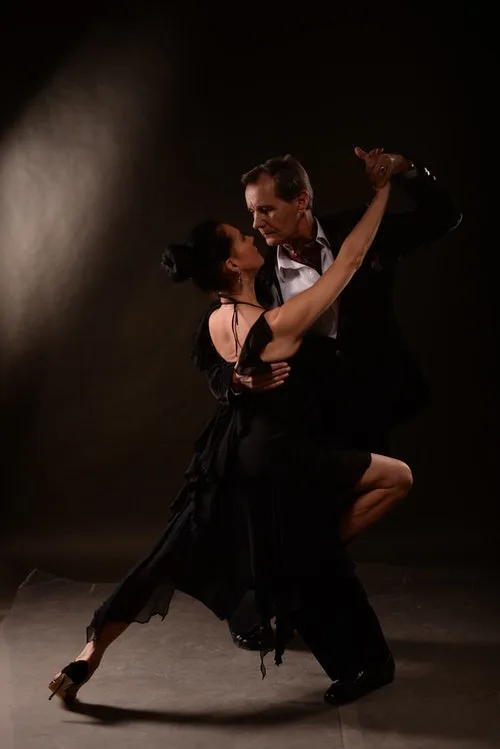 Tango — Cardiff
Class is coming soon
Fill out the form for more info
Class Details
Location: TBC
Day: TBC
Time: TBC
Age Group: 17 – 75
Teacher: —
Class Structure
Beginners Class — 60 Minutes
Finding Your Feet
We start with how you carry yourself — upright, weight gathered over one axis — and with the plain walk that underlies the whole dance. It feels far too simple to bother rehearsing, yet everything ahead is stacked on it, so you practise it alone before pairing off.
Into the Abrazo
Then the embrace. A couple learns to melt into one shared point of balance and travel about it as a single unit, rather than each person quietly guarding their own footing.
Proposing and Responding
Now you walk together, turning and shifting weight, the lead put forward through the chest while the follow listens for it and answers. The roles trade off, and the pairs keep circulating round the room.
Enough to Improvise
A few ochos, the cross and the odd giro get slipped into the walk — a vocabulary just big enough to make the dance up live instead of memorising a set sequence.
A Dance and a Stretch
The night's fragments knit into short social dances to a full tango, and a soft cool-down for the legs and lower back sees you out the door.
About Tango Classes in Cardiff
Tango is really a form of listening dressed up as dancing. Two people improvise it in a close hold, guided by the record they are sharing, and here in the capital we teach the Argentine social version — walk, embrace, the trade of leading and following, and a small set of figures you piece together live rather than commit to memory. Our tango classes in Cardiff start you right at square one.
The dance has a habit of arriving quietly and then refusing to leave — idle curiosity one month, a proper habit the next — and Cardiff keeps a small, loyal circle of dancers glad to fold you in once that happens. Sessions run at partner studios near the centre and out in leafy Pontcanna, a few minutes from Cardiff Central and Queen Street; in a flat, walkable capital with no tram to work around, getting to a weeknight class costs you almost nothing.
No partner and no track record are needed — the class rotates, so you'll have danced with everyone by the time the hour is out. Wear something smart-casual with room to move, and a shoe that turns on a smooth sole; a low heel is fine if you like one, but flats carry plenty of people through perfectly well.
Browse all 20 of our dance classes in Cardiff, or see tango classes in our other 66 cities.
Fill Out the Form for More Info
Fill in your details for up-to-date class info.
Why Choose Tango in Cardiff?
It's a Two-Way Thing
None of this is a routine to file away. The dance gets negotiated live with whoever you're holding, and it's that trading of ideas — sensing one, sending one back — that keeps people hooked on tango for decades.
Real Tango, Hour One
Since it grows straight out of a walk, you're dancing genuine tango before the first session is up — no long apprenticeship of drills to survive before the floor starts to feel like yours.
Come Solo, Dance Plenty
The whole room circulates, so nobody needs to bring anyone. Arrive by yourself and you'll partner all of it — and that constant mixing is precisely how the dance has always been handed along.
The Mind Goes Quiet
Holding your attention on a partner and a piece of music leaves no room for anything else, which is the reason dancers reach for the word meditative — for an hour, the inner monologue simply stops.
Your Tango Journey
From first class to confident dancer — here is how it usually goes.
Walk First, Everything Later
Getting Started
Posture, balance and the walk itself, plus a first tentative embrace alongside a partner. It amounts to next to nothing written down, but this genuinely is the bedrock the rest of tango stands upon.
What to Wear
Smart-casual you can move in, and shoes that spin on a smooth sole — leather does the job. A modest heel is fine but optional; the only real no is a gummy trainer that grabs at the floor.
Sharing One Balance
Building Connection
In come the cross and the weight changes, with lead and follow carried through the chest rather than tugged along by the arms. You learn to feel another person's balance as plainly as your own.
Both Roles
You take a turn at leading and at following, because understanding how the far side of the hold works quietly sharpens you into a more responsive dancer whichever one you decide to keep.
Making It Up on the Spot
Ochos and Giros
Ochos front and back, giros, and little combinations you assemble in the moment, so the dance becomes something you compose step by step rather than something you recall.
Musicality
You dance to the phrasing and, more than that, to the pauses — finding that in tango the beat you leave empty between two steps can say every bit as much as either of them.
At the Milonga
Social Dancing
You can navigate a packed floor, ask strangers to dance, and see a full tanda through without a flicker of hurry about you.
What's Next
Out past the class sit milongas here and further afield, the brighter vals and the playful milonga to widen you out, or a curious peek at the theatrical stage version of it all.
Tango in Cardiff FAQ
Everything you need to know before your first class.
Is this the tango I've seen on Strictly? +
Not the same thing, no. What turns up on Strictly is choreographed ballroom tango — bolt upright, all those crisp head turns. Ours is the Argentine kind: made up as you go, gentler on the body and held chest-to-chest in a close hold. It belongs to the social floor, not the competition stage.
Am I too old to take up tango? +
Age is rarely the barrier people dread. This dance leans on feel and rapport far more than on youth or athletic fitness, and years spent really listening to music count for plenty — which is exactly why you'll meet people picking it up well into later life.
Do I need a partner or any experience? +
Neither one. Because the room keeps rotating, anyone who shows up alone is folded in within minutes, and each session is built for people setting foot on a floor for the first time. A raw newcomer is the very person we plan the class around.
Where in Cardiff are the tango classes held? +
We work from partner studios in the city-centre core and over in Pontcanna, all a few minutes' walk from the two central stations and sitting in the flat, easily-crossed middle of the capital. Your particular room is confirmed at booking, each picked for a floor smooth enough to carry the walk.
How much do tango classes in Cardiff cost? +
A single drop-in runs to £8, and booking a block eases the price once a timetable has firmed up. There's no membership to take out and no contract to put your name to — you show up as it suits and cover only the nights you dance.
What should I wear to tango? +
Smart-casual clothing with enough give to move in, and shoes whose smooth sole lets you pivot — leather is the pick. A low heel is perfectly welcome if you fancy one, though it's never a requirement. The single thing that won't do is a rubber-gripped trainer.
Is tango hard to learn? +
More deep than difficult. The walk is yours from the first night, and with no fixed choreography looming over you, the game becomes gathering a few figures and knitting them together in whatever order takes you — and that freedom is where the enjoyment really sits.
What exactly is a milonga? +
A milonga is the social night out where tango actually gets danced — the place all these classes are quietly pointing at. There's a small but devoted circle running them in and around the capital, and we'll steer you towards it the moment you feel ready.
Will we dance to traditional tango music? +
Chiefly the traditional stuff — the great golden-age orchestras such as D'Arienzo or Pugliese — with the odd contemporary piece dropped in. Getting your ear around a tango's phrasing, and learning to play those dramatic pauses, is very much part of what the class is teaching.